












How many path lights?
Enter the length of your path and the gap you want between fittings. See the positions from above, and the quantity for your project.
How many
path lights?
Enter your path length and the gap you want between fittings. See the positions, then explore the quantity for your project.
Both ends included. Positions are equally spaced along each chosen side.
6 equal gaps of 2 m.
How far apart should path lights be?
There is no single right answer, because it depends on the fitting, its beam and how dark the surroundings are. As a starting point:
| Gap | Effect | Suits |
|---|---|---|
| 1.5 m | Pools of light that nearly meet | Steps, changes of level and short paths to a door |
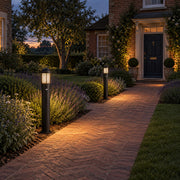
| 2 m | A clear, even route | Most garden paths |
| 3 m | Distinct pools with darker gaps between | Longer paths and brighter bollards |
| 4 m | Markers that show the line of the route | Driveways and long borders |
One side or both?
One side is enough for most garden paths, and it looks calmer. Light both sides of wide paths and driveways, or stagger the lights left and right so the gaps on one side are filled by the other.
Before you order
- If the path curves, measure along the path itself, not in a straight line between its ends.
- Put a light at each end, at steps and wherever the path changes direction, then space the rest evenly between.
- Check how each light is powered. Mains bollards need a cable run by an electrician; solar lights need direct daylight on the panel.
- Choose shielded or downward-facing fittings where you do not want to see the light source from the house.
The planner estimates quantity and placement. It does not calculate light coverage. Final spacing depends on the fitting, its beam and the surroundings.
Planning something bigger?
Send us a sketch or a few measurements and we will suggest fittings and quantities.