


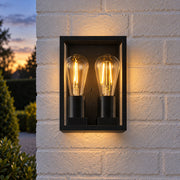
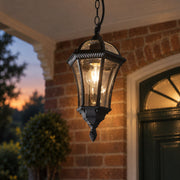


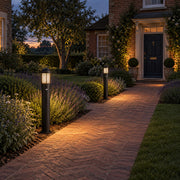
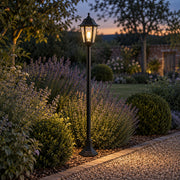

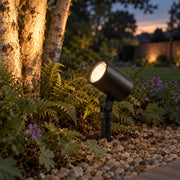


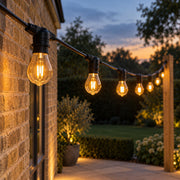

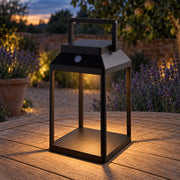


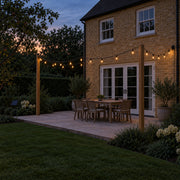


Made for the weather.
An IP rating tells you how well a fitting keeps out dust and water. It is two digits, and once you can read them, choosing for a position is simple.
Every outdoor light is rated for how well it keeps out solid objects and water. That is its IP rating, and it is listed on the product page.
How to read an IP rating
If a digit is replaced by an X, the fitting has not been rated for that kind of protection.
First digit: solids
| Digit | Protected against |
|---|---|
| 2 | Fingers and objects larger than 12.5 mm |
| 4 | Objects larger than 1 mm, such as wires and most insects |
| 5 | Dust: a little may get in, but not enough to cause harm |
| 6 | Dust tight |
Second digit: water
| Digit | Protected against |
|---|---|
| 3 | Spraying water, up to 60° from vertical |
| 4 | Splashing water from any direction |
| 5 | Water jets from any direction |
| 6 | Powerful water jets |
| 7 | Temporary immersion, up to 1 m deep for 30 minutes |
| 8 | Continuous immersion, to the depth the manufacturer states |
Which rating for which position?
IP44
The common rating for outdoor wall lights. Splash-proof from every direction, so it suits a porch or an open wall.
IP65
For walls, posts and bollards facing driving rain across open ground. By the sea the rating is only half of it: see Near the coast below.
IP67 or IP68
For fittings recessed into paths, decks and drives, where water can collect around them.
Always check the rating and the installation guidance on the product page for the exact position you have in mind.
A higher number is not always what you need
Immersion ratings (7 and 8) are tested separately from water jet ratings (5 and 6), so a higher second digit does not automatically cover the lower ones. Choose the rating that matches what the fitting will actually face, not simply the biggest number.
An IP rating also says nothing about how a finish will last, or how much light a fitting gives. Read it alongside the material, the finish and the rest of the specification.
Near the coast
Salt air is hard on metal finishes, and an IP rating does not cover corrosion. Near the sea, choose the material first: marine grade 316 or 316L stainless steel, or a fitting the maker states is built for coastal use. Then choose the IP rating for the position. Wipe fittings down with a soft, damp cloth from time to time to clear salt deposits. Our coastal lighting guide has our picks.
Let the finder narrow it down.
Three questions about your space, and a starting selection of lights that fit.