












Start with the power.
What is available where the light will go decides most of the choice. Here are the six ways to power an outdoor light, and what each one asks of you.
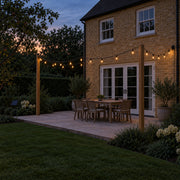
Before you fall for a fitting, look at the spot where it will go. Is there a mains supply, an outdoor socket, or nothing at all? That one answer narrows the choice more than style or finish ever will.
At a glance
| Power | Wiring needed | Best for | Watch out for |
|---|---|---|---|
| Mains (230 V) | Fixed wiring by an electrician | Walls, entrances and dependable light every night | Installation cost and the cable route |
| Low voltage (12 V or 24 V) | A transformer, then low voltage cable | Several spike, path or deck lights on one run | The total load on the power supply |
| Plug in | None: it uses a socket | Quick set-ups close to the house | A weatherproof socket and connection |
| Solar | None | Places with no supply and good daylight | Shade and short winter days |
| Rechargeable | None | Tables and anywhere you sit | Remembering to charge it |
| Replaceable battery | None | Occasional, low-level light | Changing the batteries |
Mains (230 V)
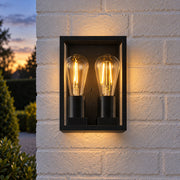
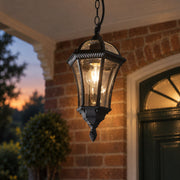
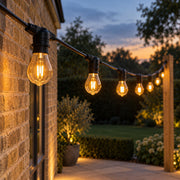
A permanent fitting connected to your home’s fixed wiring, usually controlled by a switch, a sensor or a timer. It is the choice for entrances, exterior walls and anywhere you want the same light every night without thinking about it.
Mains-powered outdoor fittings should be installed by a qualified electrician. If there is no supply at the position yet, ask for a quote before you order, because the cable route can cost more than the light.
Low voltage (12 V or 24 V)
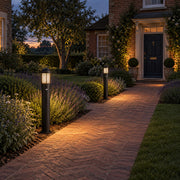
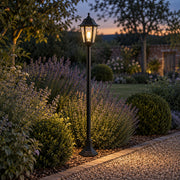
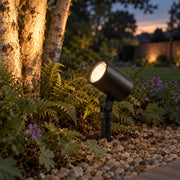
A transformer or driver steps the mains down to a low voltage, and the lights run from that. It suits garden schemes with several spike, path or deck lights on one circuit, and the cable is simpler to run through planting.
Add up the wattage of every fitting and choose a power supply with room to spare. Check that the supply, cable and connectors are all made for the same system. A qualified electrician should connect the power supply to the mains.
Shop low voltage garden lights
Plug in
The light has a plug and connects to a socket. Check the cable length and the route it will take, and that any socket or connection outdoors is protected for outdoor use.
Solar
A panel charges a battery by day and the light runs from it after dark, so there is no wiring at all. Performance depends on how much direct light the panel receives: expect shorter runtimes in winter and in shade. Solar suits marker and accent lighting, and sensor lights that only come on when they are needed.
Rechargeable
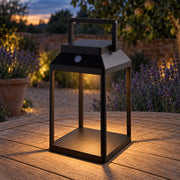
A built-in battery charged by cable or dock. Carry the light to wherever you are sitting. Compare the charging time and the runtime at the brightness you expect to use, and store it under cover unless the product page says it can stay out.
Shop rechargeable outdoor lights
Replaceable battery
Runs on standard batteries. Simple to place anywhere; check which batteries are needed and whether they are included.
Still deciding?
The lighting finder asks where you are lighting and how you would like to power it, then shows the lights that fit. Choose “Help me decide” if you are not sure.
Let the finder narrow it down.
Three questions about your space, and a starting selection of lights that fit.